Protein Sidechain Conformational Analysis
Table of Contents
- Introduction
- Conformational Analysis of Protein Sidechains
- Conformational Analysis of Backbone-Conformation Independent Interactions
- Graphical Views of the Backbone-Independent Rotamer Library
- Histograms of R1 (Chi1) Rotamer Populations
- Histograms of R1, R2 Rotamer Populations
- Histograms of Chi1 and Chi2
- Histograms of Chi1 for Each R1 Rotamer Type
- Histograms of Chi2 for Each R1 Rotamer Type
- Histograms of Chi1 and Chi2 for Each R1,R2 Rotamer
- Conformational Analysis of Backbone-Conformation Dependent Interactions
- Graphical Views of the Backbone-Dependent Rotamer Library
- 1. Histograms of Psi and Phi Dependence
- 2. Box Plots (Ramachandran Maps) of Chi1 Rotamer Preferences
- References
The site presents in detail a description of local steric
interactions that influence sidechain rotamer and chi angle
choice and includes graphical representations of the
backbone-independent and backbone-dependent rotamer libraries
developed by Dunbrack & Karplus (Ref. 1) annotated to show where
local steric interactions affect rotamer and chi angle
populations.
Syn-pentane interactions are named after the conformations of
pentane that produce repulsive steric interactions between the
terminal carbons of a 5-carbon chain. This kind of interaction occurs
when the dihedrals of pentane (C1-C2-C3-C4 and C2-C3-C4-C5) are
+60,-60 or-60,+60. These local minima on the pentane conformational
energy surface are as much as 3.5 kcal/mol higher than the trans,trans
rotamer. The figure shows the four unique structures of local energy
minima of pentane (g-,t has the same energy as g+,t by symmetry,
etc.).The dihedrals are also noted, and in the syn-pentane
conformation (g+,g-) the dihedrals are significantly skewed from the
values of the other conformers (close to 180 and +60).
If we compare the energies of pentane conformations with dihedrals
{+X,+X} with those with dihedrals of {+X,-X}, the energies of the
opposite sign pair are significantly higher than the same-sign pair
when 0 < X < 90 degrees. This is especially important in the
backbone conformation dependent analysis below. When we look at
{psi,chi1} and {phi,chi1} pairs of dihedrals we have to
look at a range around psi or phi=+60 or -60 that
includes the range 0 to 90 and -90 to 0 respectively.
These interactions occur in any hydrocarbon chain and more
generally in any chain of five heavy atoms, and can be used to find
conformations of protein sidechains with repulsive steric interactions
with backbone atoms. These interactions can be backbone-conformation
independent (the delta heavy atoms with backbone N or C form a 5 atom
chain, e.g. N-CA-CB-CG-CD) or backbone conformation dependent
(e.g. C(i-1)-N-CA-CB-CG). The backbone conformation independent
interactions depend on chi1 and chi2. The
backbone-conformation dependent interactions depend on phi or
psi and chi1. In the tables below, the various
combinations of dihedrals that produce local sidechain/backbone
interactions are described. These tables provide more explicit
information than was provided in the Nature Structural Biology paper
(Ref. 3) due to lack of space.
Because of close steric interactions between the delta carbons and the backbone
N and C atoms of residue i:
In the Newman diagram above, with the alpha carbon (not visible)
behind the beta carbon, syn-pentane interactions between delta carbons
and the local backbone are shown in red. In each of these cases, the
dihedrals (N or C)-CA-CB-CG and CA-CB-CG-CD form approximately +60,-60
or -60,+60 degree pairs of dihedrals.
Derivation of rotamer states with syn-pentane interactions for
different types of sidechains is detailed just below.
Arg,Lys,Met,Gln,Glu,Ile
r1,r2 chi1 chi1-120 chi2 Syn-pentane
(N-CA-CB-CG) (C-CA-CB-CG) (CA-CB-CG-XD) interaction
------ ----------- ----------- ------------ -----------
g+,g+ 60 -60 60 C,XD
g+,t 60 -60 180
g+,g- 60 -60 -60 N,XD
------------------------------------------------------------------
t,g+ 180 60 60
t,t 180 60 180
t,g- 180 60 -60 C,XD
------------------------------------------------------------------
g-,g+ -60 180 60 N,XD
g-,t -60 180 180
g-,g- -60 180 -60
We expect low percentages and large deviations from standard
rotamer values (chi=+60,180,-60) for rotamers with
chi1,chi2 syn-pentane interactions with the backbone N and
C. These are marked with bold italics in the table above
and those following. See the backbone-independent
rotamer library for rotamer preferences and chi angle
averages and graphical views of the
backbone-independent rotamer library below.
Leu
r1,r2 chi1 chi1-120 chi2 chi2+120 Syn-
(N-CA-CB-CG) (C-CA-CB-CG) (CA-CB-CG-CD1) (CA-CB-CG-CD2) pentane
----- ----------- ------------ -------------- ------------- -------------
g+,g+ 60 -60 60 180 C,CD1
g+,t 60 -60 180 -60 N,CD2
g+,g- 60 -60 -60 60 N,CD1; C,CD2
-----------------------------------------------------------------------------
t,g+ 180 60 60 180
t,t 180 60 180 -60 C,CD2
t,g- 180 60 -60 60 C,CD1
-----------------------------------------------------------------------------
g-,g+ -60 180 60 180 N,CD1
g-,t -60 180 180 -60
g-,g- -60 180 -60 60 N,CD2
We expect 8 backbone/CD1 (or CD2) interactions for Leu ( (CD1+CD2)
x (N and C) x 2 syn-pentane interactions (+60,-60 or -60,+60) ). Two
of these occur for the g+,g- rotamer. See the backbone-independent
rotamer library for rotamer preferences and chi angle
averages and graphical views of the
backbone-independent rotamer library below.
Phe, Tyr, His, Trp
r1 chi1 chi1-120 chi2 chi2+180 Syn-pentane
(N-CA-CB-CG) (C-CA-CB-CG) (CA-CB-CG-XD1) (CA-CB-CG-XD2) interactions
--- ----------- ----------- ------------ -------------- -----------
g+ 60 -60 60 -120 C,XD1
60 -60 120 -60 N,XD2
60 -60 -120 60 C,XD2
60 -60 -60 120 N,XD1
Conformation likely to be near chi2=+90 or -90
-------------------------------------------------------------------------------
t 180 60 60 -120
180 60 120 -60 C,XD2
180 60 -120 60
180 60 -60 120 C,XD1
Conformation likely to be chi2 ~ 70 or chi2 ~ -110
-------------------------------------------------------------------------------
g- -60 180 60 -120 N,XD1
-60 180 120 -60
-60 180 -120 60 N,XD2
-60 180 -60 120
Conformation likely to be chi2 ~ 100 or chi2 ~ -80
Aromatic sidechain chi2's are perturbed by interaction
between XD1 and XD2 and backbone N and C. Without perturbation,
chi2 would be near +90 or -90. When r1 is trans, interaction
between backbone N and XD2 and XD1 at chi2=120 or -60 pushes
the average for chi2 to values below 90 or below -90
respectively. Similarly, for r1 of g-, the averages are pushed to
values above chi2=90 and chi2=-90 by interactions of N
and XD1 and XD2 when chi2 is 60 or -120. For g+ rotamers,
interactions at chi2=60 and 120 exert steric conflict about
equally, so that chi2 averages 90 degrees. See the backbone-independent
rotamer library for rotamer preferences and chi angle
averages and graphical views of the
backbone-independent rotamer library below.
The backbone-independent library can be visualized graphically in a
number of ways. These images are all contained in Postscript files in
the tar file figures.tar.gz.
1. Histograms of r1 Rotamer Populations
We define the Chi1 rotamers ("r1") for all sidechains (except Pro) as follows
0 <= chi1 < 120 g+
120 <= chi1 < 240 t
-120 <= chi1 < 0 g-
For Proline,
chi1 >= 0 g+ (or CG-endo)
chi1 < 0 g- (or Cg-exo)
Rotamer populations for chi1 dihedrals for all sidechains
are contained in the following gif images. They are also available in
the file r1.ps contained in the large tar file. For most sidechains
g- rotamers are the most common (-120<chi1<0). Exceptions
include serine (g+ preferred) because of hydrogen bond interactions
with C=O of residue i-1. Another is valine, where trans is the most
populated rotamer because of backbone-dependent syn-pentane
interactions at heavily populated regions of the phi,psi
map. Isoleucine is quite similar to valine, but since the chi1
is defined differently for isoleucine (CG1 at chi1, CG2 at
chi1-120) than in valine (CG1 at chi1, and CG2 at
chi1+120), the equivalent rotamer for Ile is g-. Threonine has
a chi1 angle defined like that of isoleucine. Thr is like Ile
in its chi1 distribution, but in addition, like serine it has a
large increase in g+ rotamers because of hydrogen bonding effects.
G,D G,2D 2G+Pro
Arg and Lys Asp and Asn Val and Ile
Glu and Gln Phe and Tyr Thr and Pro
Met and Leu His and Trp
Ser and Cys
2. Histograms of r1, r2 Rotamer Populations
Rotamer populations for a pair of dihedral angles can be expressed
as either joint probabilities, i.e. r1 (the chi1 rotamer) is
trans AND r2 (the chi2 rotamer) is g+ or by conditional
probabilities, i.e. the probability that r2 is g+ given that r1 is
trans. The former is expressed as p(r1,r2) and the latter is expressed
as p(r2|r1). Bayes rule defines p(r2|r1) = p(r1,r2)/p(r1). In all of
these figures, syn-pentane rotamers are represented by solid red bars
and non-syn-pentane rotamers are represented by striped blue bars.
For all sidechain types listed just below except Trp, the r2
rotamer populations are defined like those for r1 above. For Trp, the
chi2 angle probability is near 0 at chi2=180 and is
larger than 0 at chi2=0 where there is a small hump in the
chi2 distribution. Therefore it makes sense to split the
rotamer definitions at 180, 60, and -60, rather than 0,120 and
-120. Of course, since there is a heavy atom at chi2+180, this
is similar to defining the chi2 rotamers in terms of CD2 instead of
CD1 where CA-CB-CG-CD2 is 0, 120, -120 at the boundaries between
chi2 rotamers.
60 <= chi2 < 180 g+
-60 <= chi2 < 60 t
-180 <= chi2 < -120 g-
Arg Lys Glu Gln Met Ile Leu Trp
3. Histograms of chi1 and chi2
These are simply histograms of chi1 and chi2 with all rotamers lumped together on the same plot.
G,D G,2D 2G
Cys Phe Val
Ser Tyr Thr
Arg His Ile
Lys Trp
Glu Asn Pro
Gln Asp
Met Leu
4. Histograms of chi1 for each r1 rotamer type
The three chi1 histograms are shown in parallel to show
small differences in the skew and tail regions of the three rotamer
types. Note that chi1=0 and chi1=120 bring the gamma
carbon cis to the backbone N and C while chi1=240 (-120) brings
it cis to the backbone HA. The trans and g- distributions are both
skewed toward -120 (chi1=-170 and -70 respectively) slightly (i.e.
away from chi1=0 amd chi1=120).
G,D G,2D 2G
Cys Phe Val
Ser Tyr Thr
Arg His Ile
Lys Trp
Glu Asn Pro
Gln Asp
Met Leu
5. Histograms of chi2 for each r1 rotamer type
In these figures the syn-pentane regions for chi2 have been
colored red with the rest of chi2 colored blue. The low
populations for the syn-pentane chi2 regions are evident. Note for
Asn, chi2 has been plotted in the range -180,180. Asp and
Asp+Asn have been plotted in the range -90,90, where 180 has been
added or subtracted to chi2 to bring the value into this
range. Chi2 peaks near 0 degrees for both Asn and Asp, so it is
helpful to have 0 degrees plotted in the middle of the range. For
aromatics, the peak is near 90 degrees, so chi2 is plotted from
0 to 180 (Trp from -180 to 180).
G,D G,2D 2G+Pro
Arg,Lys,Glu,Gln,Met(total) Asp + Asn Ile
Arg Asn Pro
Lys Asp
Glu Phe+Tyr+His
Gln Phe
Met Tyr
His
Trp
Leu
6. Histograms of chi1 and chi2 for each r1,r2 rotamer
These figures show in more detail the shapes of chi1 and
chi2 angle distributions that are strongly affected by
interactions with the backbone. In most cases, there are too few data
for the syn-pentane rotamers, and these figures appear noisy. The
summed distribution (Arg, Lys, Glu, Gln, Met) is clearest.
Arg,Lys,Glu,Gln,Met r1=g+ Arg,Lys,Glu,Gln,Met r1=t Arg,Lys,Glu,Gln,Met r1=g-
Arg r1=g+ Arg r1=t Arg r1=g-
Lys r1=g+ Lys r1=t Lys r1=g-
Glu r1=g+ Glu r1=t Glu r1=g-
Gln r1=g+ Gln r1=t Gln r1=g-
Met r1=g+ Met r1=t Met r1=g-
Ile r1=g+ Ile r1=t Ile r1=g-
Leu r1=g+ Leu r1=t Leu r1=g-
Trp r1=g+ Trp r1=t Trp r1=g-
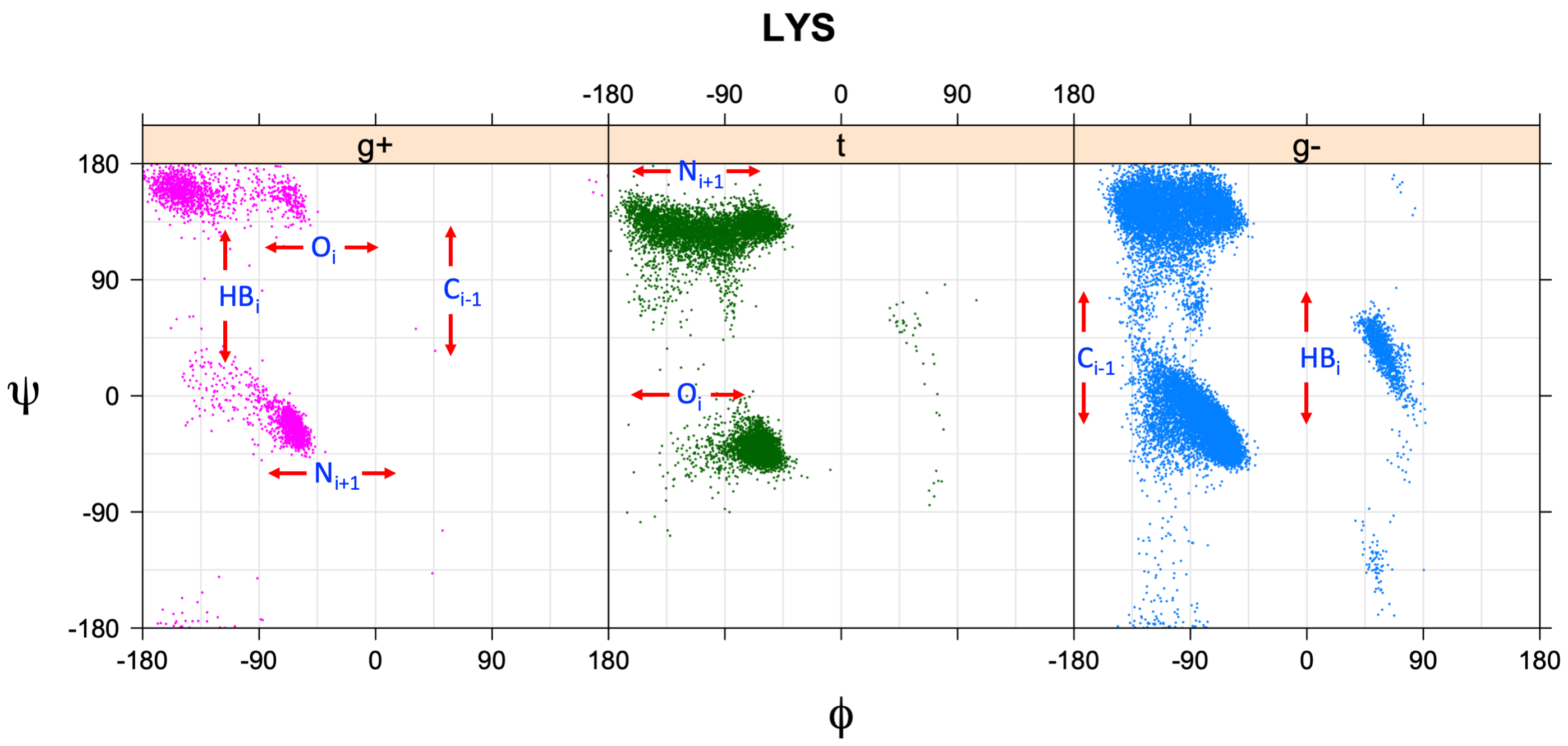
Backbone-conformation dependent
interactions occur between gamma heavy atoms (CG,OG,OG1,CG1,CG2,SG)
and backbone C(i-1) (of previous amino acid), backbone N(i+1) (of next
amino acid), backbone O(i) (of same amino acid) and hydrogen bond
donor to backbone N(i) of same amino acid ("HB" below,
assuming linear hydrogen bond between oxygen and H-N bond). These
interactions are expected to be strongly repulsive when dihedrals
connecting these heavy atoms to gamma heavy atoms occur in +60,-60 or
-60,+60 pairs. They will occur in a range about the phi and
psi dihedrals that cause the connecting dihedrals to the
backbone to be near +60 or -60 (when connecting dihedral to XG is -60
or +60 respectively). In each case, the dihedrals needed are of the
form: X1-X2-X3-X4 and X2-X3-X4-X5. So for instance for psi
dependent interactions, the dihedrals are N(i+1)-C-CA-CB and
C-CA-CB-XG or psi+120 and chi1-120 respectively. These
are tabulated below for instances where syn-pentane interactions are
expected. Val, Ile, and Thr are tabulated separately, since these
amino acids have 2 gamma heavy atoms. Interactions with "HB"
are expected to be weak, but the backbone-dependent rotamer library
does exhibit effects due to this interaction.
Note: we need to observe ranges of phi and psi of 0
to 90 and -90 to 0, for g- and g+ dihedrals of the sidechain. Since
chi1 is always an sp3-sp3 dihedral with local minima around
180, +60, and -60 degrees, chi1 (or chi1-120)
will always fall in the -90 to 0 or 0 to 90 range. Phi and
psi are both sp2-sp3 dihedrals, which do not have barriers as
high as sp3-sp3 dihedrals. They can take on a somewhat broader range
of dihedrals than sp3-sp3 bonds. Hence, we locate 90 degree intervals
of phi and psi that will conflict with certain
chi1 rotamers to search for likely steric conflicts. These
ranges are colored red or green in the histograms of rotamer populations as a function
of phi and psi below.
So,
Lys,Arg,Met,Gln,Glu,Asp,Asn,Ser,Cys,Leu
phi-120 chi1 r1 phi Syn-
C(i-1)-N-CA-CB N-CA-CB-XG C(i-1)-N-CA-C pentane
-------------- ---------- ---- ----------- --------
+60 -60 g- -180 C_1,XG
-60 +60 g+ 60 C_1,XG
phi+60 chi1 r1 phi Syn-
HB-N-CA-CB N-CA-CB-XG C(i-1)-N-CA-C pentane
----------- ---------- --- ----------- -------
+60 -60 g- 0 HB,XG
-60 +60 g+ -120 HB,XG
psi+120 chi1-120 r1 psi Syn-
N(i+1)-C-CA-CB C-CA-CB-XG N(i+1)-C-CA-N pentane
----------- ----------- --- ----------- --------
+60 -60 g+ -60 N+1,XG
-60 +60 t 180 N+1,XG
psi-60 chi1-120 r1 psi Syn-
O-C-CA-CB C-CA-CB-XG N(i+1)-C-CA-N pentane
---------- ----------- --- ----------- --------
+60 -60 g+ 120 O,XG
-60 +60 t 0 O,XG
Val
phi-120 chi1,chi1+120 r1 phi Syn-
C(i-1)-N-CA-CB N-CA-CB-CG1,2 C(i-1)-N-CA-C pentane
------------ ------------ --- ------------- --------
+60 -60, +60 g- -180 C_1,CG1
+60 180, -60 t -180 C_1,CG2
-60 +60, 180 g+ 60 C_1,CG1
-60 -60, +60 g- 60 C_1,CG2
phi+60 chi1,chi1+120 r1 phi Syn-
HB-N-CA-CB N-CA-CB-CG1,2 C(i-1)-N-CA-C pentane
----------- ------------ --- ------------- ------
+60 -60, +60 g- 0 HB,CG1
+60 180, -60 t 0 HB,CG2
-60 +60, 180 g+ -120 HB,CG1
-60 -60, +60 g- -120 HB,CG2
psi+120 chi1-120,chi1 r1 psi Syn-
N(i+1)-C-CA-CB C-CA-CB-CG1,2 N(i+1)-C-CA-N pentane
----------- -------------- --- ------------ ------
+60 -60,+60 g+ -60 N+1,CG1
+60 180,-60 g- -60 N+1,CG2
-60 +60,180 t 180 N+1,CG1
-60 -60,+60 g+ 180 N+1,CG2
psi-60 chi1-120,chi1 r1 psi Syn-
O-C-CA-CB C-CA-CB-CG1,2 N(i+1)-C-CA-N pentane
---------- ------------- --- ------------ -------
+60 -60,+60 g+ 120 O,CG1
+60 180,-60 g- 120 O,CG2
-60 +60,180 t 0 O,CG1
-60 -60,+60 g+ 0 O,CG2
Val has CG1 at chi1 and CG2 at chi1+120. Because Val g+ and g-
conformations have steric interactions with the backbone near psi=120
and -60 (the most populated psi ranges), Val is the only amino acid
where the t rotamer (chi1~180) is the most common.
Ile,Thr
phi-120 chi1,chi1-120 r1 phi Syn-
C(i-1)-N-CA-CB N-CA-CB-CG1,2 C(i-1)-N-CA-C pentane
------------ ------------ --- ------------- -------
+60 -60, 180 g- -180 C_1,CG1
+60 +60, -60 g+ -180 C_1,CG2
-60 +60, -60 g+ 60 C_1,CG1
-60 180, +60 t 60 C_1,CG2
phi+60 chi1,chi1-120 r1 phi Syn-
HB-N-CA-CB N-CA-CB-CG1,2 C(i-1)-N-CA-C pentane
----------- ------------ --- ------------- -------
+60 -60, 180 g- 0 HB,CG1
+60 +60, -60 g+ 0 HB,CG2
-60 +60, -60 g+ -120 HB,CG1
-60 180, +60 t -120 HB,CG2
chi1+120
psi+120 chi1-120 r1 psi Syn-
N(i+1)-C-CA-CB C-CA-CB-CG1,2 N(i+1)-C-CA-N pentane
----------- -------------- --- ----------- -------
+60 -60, +60 t -60 N+1,CG1
+60 180, -60 g+ -60 N+1,CG2
-60 +60, 180 g- 180 N+1,CG1
-60 -60, +60 t 180 N+1,CG2
chi1+120
psi-60 chi1-120 r1 psi Syn-
O-C-CA-CB C-CA-CB-CG1,2 N(i+1)-C-CA-N pentane
---------- ------------- --- ------------ -------
+60 -60, +60 t 120 O,CG2
+60 180, -60 g+ 120 O,CG1
-60 +60, 180 g- 0 O,CG2
-60 -60, +60 t 0 O,CG1
Ile has CG1 at chi1 and CG2 at chi1-120. Thr has OG1 at chi1 and CG2 at chi1-120.
We expect low percentages and large deviations from standard rotamer values
(chi=+60,180,-60) for rotamers with chi1,chi2 syn-pentane interactions with the backbone N and C.
The library can be visualized graphically in a number of ways.
1. Histograms
First, as histograms for the three chi1 rotamers as
a function of one of the backbone dihedrals (phi or psi). To
separate out dependence on the other backbone dihedral, a range of
this dihedral is used. For the graphs of psi dependence, a
range of phi from -140 to -40 was used to avoid the
phi-dependent interactions at phi=-180 and 0 on g-
rotamers. Several examples follow, and the regions where syn-pentane
interactions occur are highlighted with red bars (interaction of CG
with O(i) of the same ith amino acid and with green bars (interaction
of CG with N(i+1). The effect of the steric interactions is
self-evident in lowering the occupancy of certain chi1 rotamers
as a function of psi and altering the average chi1
dihedral in these regions away from the canonical values of +60, 180,
and -60.
Psi Dependence
R+K+M+E+Q r1=g+ R+K+M+E+Q r1=t R+K+M+E+Q r1=g-
Arg r1=g+ Arg r1=t Arg r1=g-
Lys r1=g+ Lys r1=t Lys r1=g-
Gln r1=g+ Gln r1=t Gln r1=g-
Glu r1=g+ Glu r1=t Glu r1=g-
Met r1=g+ Met r1=t Met r1=g-
Ser r1=g+ Ser r1=t Ser r1=g-
Cys r1=g+ Cys r1=t Cys r1=g-
Phe+Tyr+His r1=g+ Phe+Tyr+His r1=t Phe+Tyr+His r1=g-
Phe r1=g+ Phe r1=t Phe r1=g-
Tyr r1=g+ Tyr r1=t Tyr r1=g-
His r1=g+ His r1=t His r1=g-
Trp r1=g+ Trp r1=t Trp r1=g-
Asp+Asn r1=g+ Asp+Asn r1=t Asp+Asn r1=g-
Asp r1=g+ Asp r1=t Asp r1=g-
Asn r1=g+ Asn r1=t Asn r1=g-
Leu r1=g+ Leu r1=t Leu r1=g-
Val+Ile r1=g+ Val+Ile r1=t Val+Ile r1=g-
Ile r1=g+ Ile r1=t Ile r1=g-
Val r1=g+ Val r1=t Val r1=g-
Thr r1=g+ Thr r1=t Thr r1=g-
Pro r1=g+ Pro r1=t Pro r1=g-
Phi Dependence
R+K+M+E+Q r1=g+ R+K+M+E+Q r1=t R+K+M+E+Q r1=g-
Arg r1=g+ Arg r1=t Arg r1=g-
Lys r1=g+ Lys r1=t Lys r1=g-
Gln r1=g+ Gln r1=t Gln r1=g-
Glu r1=g+ Glu r1=t Glu r1=g-
Met r1=g+ Met r1=t Met r1=g-
Ser r1=g+ Ser r1=t Ser r1=g-
Cys r1=g+ Cys r1=t Cys r1=g-
Phe+Tyr+His r1=g+ Phe+Tyr+His r1=t Phe+Tyr+His r1=g-
Phe r1=g+ Phe r1=t Phe r1=g-
Tyr r1=g+ Tyr r1=t Tyr r1=g-
His r1=g+ His r1=t His r1=g-
Trp r1=g+ Trp r1=t Trp r1=g-
Asp+Asn r1=g+ Asp+Asn r1=t Asp+Asn r1=g-
Asp r1=g+ Asp r1=t Asp r1=g-
Asn r1=g+ Asn r1=t Asn r1=g-
Leu r1=g+ Leu r1=t Leu r1=g-
Val+Ile r1=g+ Val+Ile r1=t Val+Ile r1=g-
Ile r1=g+ Ile r1=t Ile r1=g-
Val r1=g+ Val r1=t Val r1=g-
Thr r1=g+ Thr r1=t Thr r1=g-
Pro r1=g+ Pro r1=t Pro r1=g-
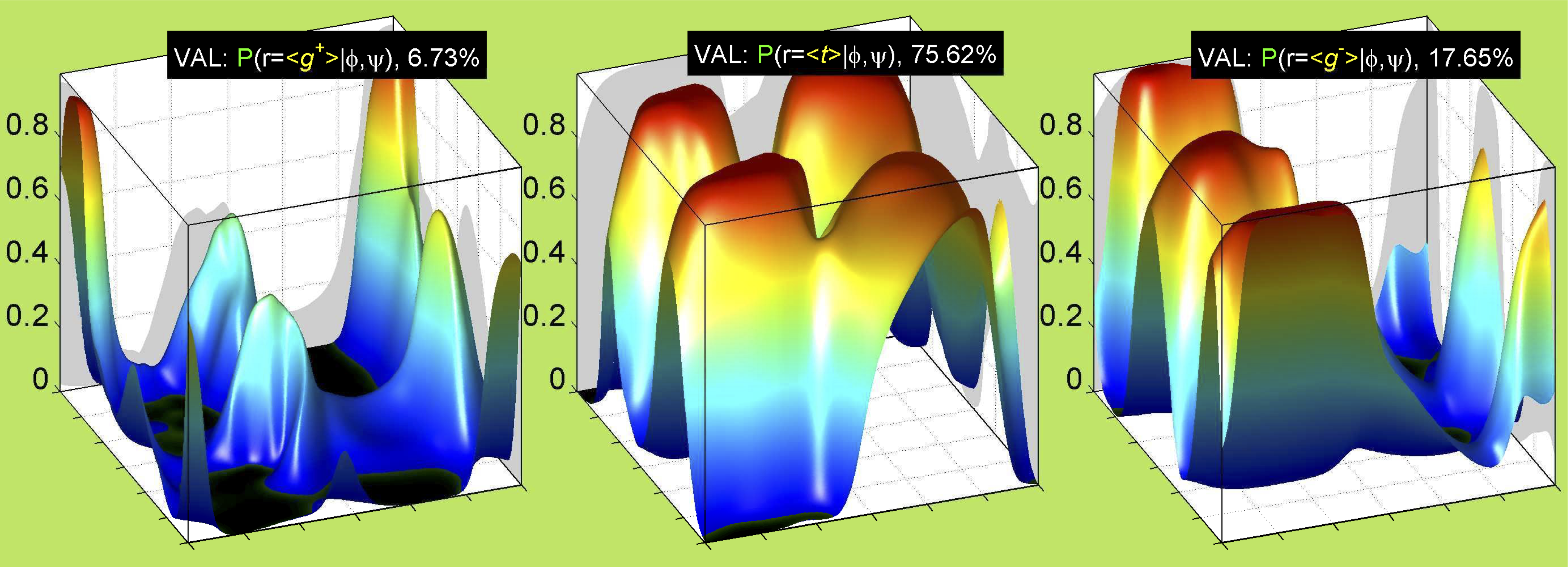
2. Box plots
Second, the phi and psi dependence can be illustrated
simultaneously in box plots. The width of the boxes located at each
phi,psi point in a Ramachandran map are proportional to the
percentage of rotamers for that phi,psi that are a particular
rotamer (one graph for each of the g+, t, and g- rotamers). Again, the
summed distribution (Arg, Lys, Glu, Gln, Met) is clearest. Postscript
versions of these plots are in the tar file as boxplots.ps.
Ser r1=g+ Ser r1=t Ser r1=g-
Cys r1=g+ Cys r1=t Cys r1=g-
Arg,Lys,Glu,Gln,Met r1=g+ Arg,Lys,Glu,Gln,Met r1=t Arg,Lys,Glu,Gln,Met r1=g-
Arg r1=g+ Arg r1=t Arg r1=g-
Lys r1=g+ Lys r1=t Lys r1=g-
Glu r1=g+ Glu r1=t Glu r1=g-
Gln r1=g+ Gln r1=t Gln r1=g-
Met r1=g+ Met r1=t Met r1=g-
Phe+Tyr+His r1=g+ Phe+Tyr+His r1=t Phe+Tyr+His r1=g-
Phe r1=g+ Phe r1=t Phe r1=g-
Tyr r1=g+ Tyr r1=t Tyr r1=g-
Trp r1=g+ Trp r1=t Trp r1=g-
Asp+Asn r1=g+ Asp+Asn r1=t Asp+Asn r1=g-
Asp r1=g+ Asp r1=t Asp r1=g-
Asn r1=g+ Asn r1=t Asn r1=g-
Leu r1=g+ Leu r1=t Leu r1=g-
Val r1=g+ Val r1=t Val r1=g-
Ile r1=g+ Ile r1=t Ile r1=g-
Thr r1=g+ Thr r1=t Thr r1=g-
Pro r1=g+ Pro r1=g-
- R. L. Dunbrack, Jr. and M. Karplus. "Backbone-dependent
Rotamer Library for Proteins: Application to Side-chain
prediction." J. Mol. Biol., 230, 543-574 (1993).
- R. L. Dunbrack, Jr. Conformational analysis of protein
sidechains: Empirical energy parameters for proline and development of
a backbone-dependent rotamer library. Ph. D. dissertation, Harvard
University (1993).
- R. L. Dunbrack, Jr. and M. Karplus. "Conformational analysis
of the backbone-dependent rotamer preferences of protein
sidechains." Nature Structural Biology, 1, 334-340
(1994).
- J.W. Ponder and F.M. Richards. "Tertiary templates for
proteins. Use of packing criteria in the enumeration of allowed
sequences for different structural classes.
J. Mol. Biol., 193, 775-791 (1987).
- R. L. Dunbrack, Jr. and F. E. Cohen. Bayesian statistical
analysis of protein sidechain rotamer preferences. Protein
Science, 6, 1661-1681 (1997).
|